
23rd September 2024
Can volunteering help tackle low youth voter turnout?
Young people throughout Europe, particularly those from poorer backgrounds, are increasingly unlikely to vote in national elections. This blog discusses recent research showing that volunteering can help connect young people – particularly those from poorer backgrounds – with electoral politics, but that the benefits are greater for young men than young women. Volunteer-involving organisations with young people have a crucial role to play in encouraging youth voter turnout.
Falling voter turnout among young generations is a long-standing challenge confronting many democratic countries: young people today are less likely to vote than their parents or grandparents were at a similar age. Young people have always been somewhat less likely to vote than their elders, and to become more likely to vote as they get older, but low youth turnout is particularly problematic because voting is habitual: people who get into a habit of voting from a young age are likely to keep voting, while those who form habits of non-voting are likely to remain lifelong abstainers. More concerning still is that it is those young people from the poorest backgrounds who are the least likely to vote. The result is a growing generational divide in voter turnout, in which the poorest young people are disproportionately under-represented compared with previous generations at the same age.
This trend has spurred renewed interest in the potential for volunteering – whether in the form of international programmes (such as European Solidarity Corps), service learning (such as National Citizen Service), community and neighbourhood volunteering or membership of localised voluntary associations (such as Scouts) – to help engage more young people with electoral politics. While there is plenty of evidence to show that people who volunteer in childhood are more likely to vote in adulthood than those who didn’t volunteer, this doesn’t necessarily mean that volunteering made those young people more likely to vote. Instead, it could reflect the fact that young people from wealthier households raised by politically engaged parents are more likely to both volunteer in childhood and vote in adulthood. Or, put another way, the average young volunteer is very likely to vote when they get older, regardless of their voluntary activity, because of their upbringing. The key challenge for recent research, therefore, has been to find out whether volunteering increase youth voter turnout once those other factors that so heavily influence whether children are likely to vote in adulthood have been accounted for.
Looking specifically at the effect of volunteering on youth voter turnout, my research used the Understanding Society survey to analyse whether first-time voters in the 2015, 2017 and 2019 general elections who volunteered became more likely to vote, after accounting for the political engagement of their parents. Respondents were asked to rate their likelihood of voting in their first election on a scale from 0 (meaning ‘certain not to vote’) to 10 (‘certain to vote’). For those who volunteered and were raised by parents who were not interested in politics (who were also more likely to be poorer and living in rented accommodation), the average vote likelihood increased from 6.3 to 6.8. For those who volunteered and were raised by politically engaged (and likely wealthier) parents, however, there was no change at all in their likelihood of voting: it stuck at 8.1 whether they volunteered or not . This suggests that volunteering has the greatest impact on a young person’s likelihood of voting if they are raised in a household that did not engage with politics.
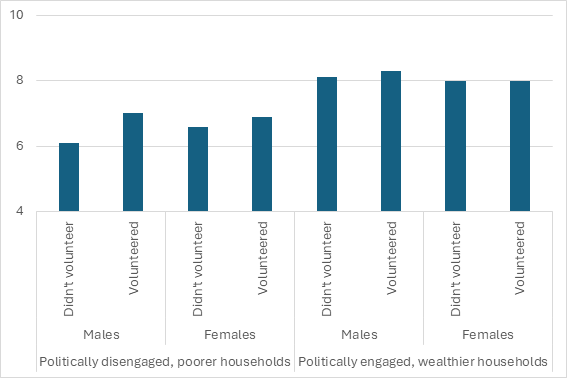
Surprisingly, however, there was a further difference in the benefit of volunteering depending on the sex of the volunteer. The graph below shows the change in vote likelihood for young men and women depending on whether they were raised by politically engaged or disengaged parents: for both men and women, the benefit of volunteering was still greater for those raised in disengaged households, but the benefit for young men was much greater than that for young women. while the benefit of volunteering was still greater for the latter, it was stronger still for young men . A young man from a politically disengaged household saw their vote likelihood increase from 6.3 to 7.0 if they volunteered; for young women from such households, the increase 6.6 to 6.9. A young man from a politically engaged household also saw some benefit from volunteering, with their likelihood increasing from 8.1 to 8.3, compared with no change at all for young women from such households, whose likelihood stayed at 8.0 whether they volunteered or not. These findings demonstrate that young men, particularly those from politically disengaged upbringings, experience the greatest benefit of volunteering on their likelihood to vote.
Therefore, research increasingly identifies volunteering as a way of reducing inequalities in voter turnout between young people from wealthier and poorer backgrounds. VIOs working with young people have an important role to play in combating generational turnout decline. The extent to which this can be achieved depends on the success of volunteer associations and programmes in recruiting young people from more deprived households with politically disengaged parents – as they are the least likely to vote and have the most to gain from volunteering. Despite the commendable efforts of researchers, the third sector, volunteers, schools and communities, volunteering in the UK remains characterised by a large socio-economic divide. This raises the question of VIOs’ role in tackling the persistent socio-economic barrier in youth-volunteering. For example, how can your organisation include young volunteers, especially men, from poorer socio-economic backgrounds , both in terms of recruitment and management? And what kinds of volunteering opportunities do you need to make available for volunteering to appeal to them specifically, and not just their counterparts from wealthier backgrounds? A clear priority for further research is better understanding and overcoming this persistent socio-economic barrier.
Finally, a further question posed by the data above is why there is such a stark difference in the benefits of volunteering for young men and young women? The most plausible theory is that this reflects the types of volunteer activities young men and women are likely to participate in – with men more likely to favour volunteering for organisations directly related to politics (such as political parties or trade unions) from which skills promoting electoral participation are more readily learned. Until more research sheds light on this issue, however, we will be unable to fully understand nor try to resolve this major divide in the electoral benefits of volunteering for young people.
If you have questions about the research discussed in this blog or would like more information, please email S.Fox2@exeter.ac.uk. If you’d like to learn more about research relating to volunteering and political participation, you can sign up to Stuart Fox’s Social Action as a Route to the Ballot Box newsletter to receive regular updates. Simply email S.Fox2@exeter.ac.uk and ask to be added to the mailing list.

By Dr Stuart Fox
S.Fox2@exeter.ac.uk